
The statistics cannot be clearer because they show that out of five people who search online, four of them actually have the intention of buying something or completing an action, but, they need more information before they finally make their decision. This is why hiring an SEO consultant becomes critical when your business is losing your potential customers to your competitors. It becomes a “hard pill to swallow” when you become aware that customers flock to your competitors’ businesses instead of yours in spite of all the efforts and money you have invested.
Let’s explore the real facts, facts which come from reputable sources:
A website or a webpage that ranks #1 on Google’s SERP (Search Engine Result Page), on average gets double CTR (Click-Through-Rate) than the page that ranks second. Back in the day, in 2007, when I started my SEO journey, it was good to rank in the top ten positions and still get quality clicks that convert but these days, the story is completely different. Visitors are more internet-savy, search results are more refined, competitions are more fierce and so, the only “survivor target” you have is the coveted first position on search platforms.
Not only on Google, but on other search engines such as Yahoo, Bing as well as others that are not as powerful.
Then, you want to be quoted by Google Overviews, ChatGPT, Claude and Perplexity to name but a few. Ride along with me and I will show you how your business can harness all the opportunities available today as far as online visibility is concerned.
You might want to hire an SEO consultant to carry out the task for you through knowledge and expertise.
What You Should Know: Key Takeaways
When 75% of searchers never scroll past Google’s first page and the #1 result gets 2X more clicks than #2, your search ranking directly controls whether customers find you or your competitors. Here’s what you need to know about stopping customer loss through SEO consulting:
- Poor rankings can cost your business revenue: The amount of revenue loss depends on business size and the industry. Small businesses can lose revenues in tens of thousands of dollars while bigger companies can lose revenue in millions of dollars annually if they rank poorly on SERPs.
- SEO delivers exceptional ROI: Professional SEO generates a median 748% return ($7.48 per dollar spent) with organic leads closing at 14.6% versus just 1.7% for outbound marketing.
- Competitors win through specific advantages: Higher keyword rankings, faster site performance, stronger backlink profiles, comprehensive content strategies, and optimized local presence create measurable visibility gaps.
- Professional consultants provide systematic solutions: Through comprehensive audits, keyword strategy, technical fixes, content gap analysis, link building, and ongoing monitoring—addressing root causes rather than symptoms.
- Results require patience but compound over time: Expect initial improvements within 6-12 months, with peak results in years 2-3, but unlike paid ads, SEO continues delivering traffic without incremental spend after initial investment.
The decision to hire an SEO consultant becomes urgent when you have identified ranking gaps actively diverting customers to competitors. Starting today protects tomorrow’s revenue, as the six-month timeline means delays compound your competitive disadvantage.
The Real Cost of Losing Customers to Competitors
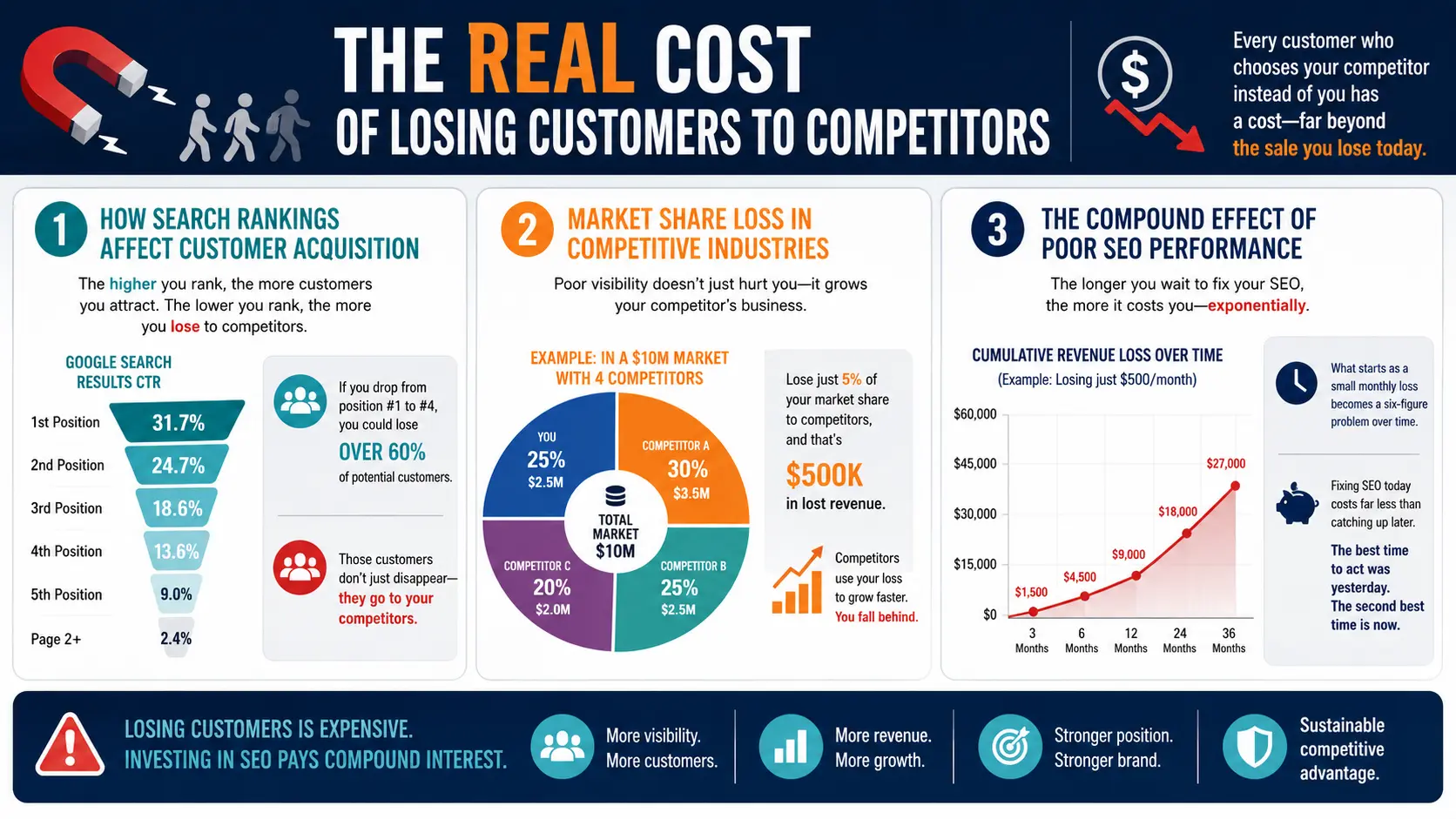
“Losing to cheaper competitors isn’t a pricing problem; it’s a value communication problem.” — Jeremy Lee Miner, Sales expert.
Search visibility determines whether potential customers find your business or hand their money to competitors who rank above you. Most business owners don’t realize how high the financial stakes run.
How Search Rankings Affect Customer Acquisition
Your position in search results controls your customer pipeline when 68% of online experiences begin with a search engine. The numbers paint a stark picture: 75% of searchers never scroll past the first page of results. Drop to page two and you’ve disappeared from the buying conversation.
The map pack placement creates an even sharper divide. Those three local business positions capture 42% of all clicks for local searches. That figure jumps to 74% on mobile devices, where local intent peaks. A commercial HVAC company tracked this gap over 18 months. Their lead volume told the story: 67 inbound calls weekly when ranking in the map pack versus 31 calls when sitting below it. Same business, same website, similar advertising budget. Search position was the only variable.
One case study reveals the true cost of declining search rankings. A business that stopped investing in SEO saw their daily organic leads plummet from 5 to just 1 over three years. That represents an 80% drop in lead generation. Those lost 120 monthly leads translated to 14 missed sales with a 12% lead-to-customer conversion rate and average deal value of $6,600. The revenue effect: $92,00 per month or $1,100,000 annually.
Factor in repeat customers and lifetime value, and the actual cost exceeds $1 million. This wasn’t a sudden collapse. The business managed to keep decent keyword rankings at first, though no longer in top positions. Traffic declined as competitors invested while they stood still. Market share doesn’t stay static when rivals are pursuing the same customers.
The Compound Effect of Poor SEO Performance
SEO decline operates through compounding deterioration on multiple fronts. Competitor activity accelerates past you when you pause optimization efforts. New rivals enter the market constantly and raise the baseline effort needed to maintain position. Each algorithm update from Google shifts ranking factors. Your site falls behind current quality standards without active monitoring and adjustment.
User experience degrades as site speed lags behind evolving standards. Visitors notice when competitors offer faster, smoother experiences. Search engines notice too, since engagement metrics influence rankings. Content grows stale without fresh material addressing current search trends. Google prioritizes recent, helpful information that demonstrates expertise and authority.
Link profiles decay over time as external websites update or archive content containing your backlinks. Yours drop off naturally while competitors build authoritative new links. Recovering from this link erosion takes considerable time and outreach effort, making it the most challenging aspect of SEO neglect to reverse.
Stopping SEO investment doesn’t crash your traffic like pausing paid ads would. The erosion happens slowly, masked by residual momentum from past efforts. That decline makes the problem easy to ignore until revenue damage becomes severe and expensive to repair.
Key Reasons Your Competitors Are Winning Online
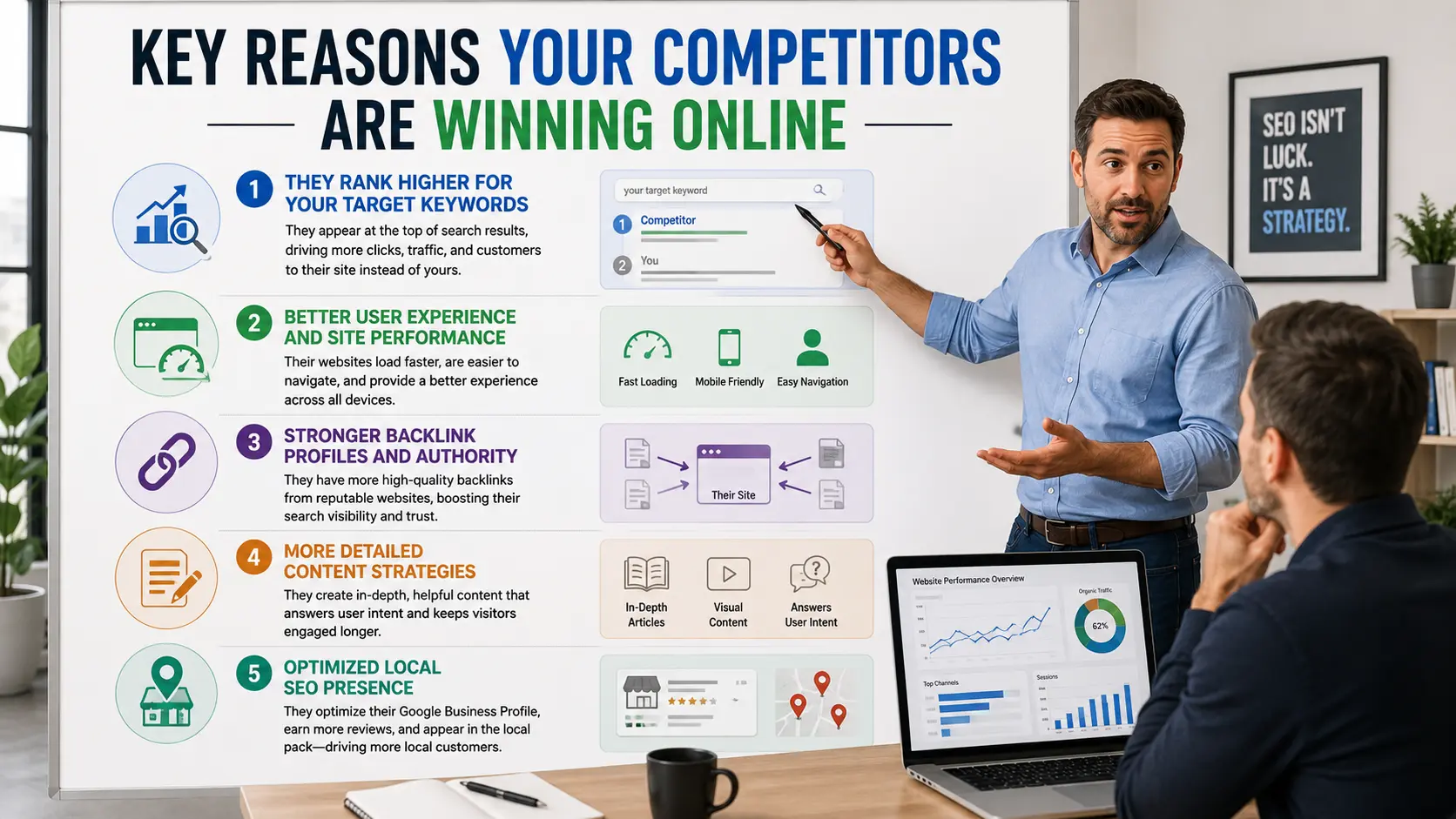
Google doesn’t reward effort or business quality. It rewards measurable optimization factors that signal relevance, authority and user satisfaction. Specific tactical gaps explain the disparity if competitors outrank you.
They Rank Higher for Your Target Keywords
Keyword gap analysis reveals where competitors capture search traffic you’re missing. These gaps represent actual customer searches directing prospects to rival websites instead of yours. SEO competitors aren’t always your business competitors. A Nike competitor for “running shoes for flat feet” isn’t just Adidas or Brooks, but also Runner’s World appearing as the first organic result.
Tools show which keywords competitors rank in positions 1-5 while you sit in positions 11-30. Those represent your fastest wins since you’re in the game but losing visibility. High-intent commercial keywords driving conversions often hide in competitor profiles alongside informational queries supporting their content strategy. You uncover page 2 rankings that could reach page 1 and new topic clusters you haven’t covered yet if you hire an SEO consultant for keyword research services.
Better User Experience and Site Performance
Page speed affects both rankings and user retention. Google confirmed site speed as a ranking factor over a decade ago. Sites loading under two seconds hold measurable advantages over those taking four or five seconds. Research shows 53% of mobile sites get abandoned if loading exceeds three seconds.
Core Web Vitals assess how quickly items load and how smoothly users experience your site. Google uses mobile-first indexing, meaning it evaluates and ranks the mobile version of your site. Poor mobile performance tanks rankings whatever your desktop speed. User involvement signals like bounce rate, dwell time and pages visited shape search rankings. Search engines interpret this as irrelevant or unsatisfactory content if visitors leave quickly due to poor UX.
Stronger Backlink Profiles and Authority
Domain Rating relates to keyword rankings across 218,713 domains studied. Sites with more unique referring domains demonstrate higher authority scores. The number of referring domains to a page represents the strongest backlink factor for rankings that relates.
Quality matters more than quantity. One backlink from CNN.com outweighs thousands from mediocre websites. High authority domains linking to competitor content signal value to Google’s algorithm. You identify domains linking to multiple competitors but not to you, plus industry publications featuring similar brands if you hire a link building consultant.
More Detailed Content Strategies
Competitors with 40 in-depth articles on a subject versus your three earn topical authority recognition from Google. That authority lifts all their related content, including pages competing with yours. Strategic content frameworks using topic clusters and pillar pages signal expertise better than scattered blog posts.
Better content means more specific answers to exact search queries and clearer structure with scannable headers and bullet points. Current information demonstrates active maintenance, and authoritative backing with data and examples. Content gap analysis through search engine optimization consultant services reveals topics competitors cover that you don’t.
Optimized Local SEO Presence
Local SEO narrows competition from global to geographic relevance. Appearing in the local three-pack captures 42% of all clicks for local searches. Google ranks local businesses based on relevance to the user’s query, distance from the searcher and prominence through reviews and recognition.
More reviews and higher ratings improve both rankings and click-through rates. NAP citations (name, address, phone number) that are consistent across directories build confidence in your business legitimacy. The question of hiring an SEO consultant becomes urgent for local businesses missing these optimization signals that technical SEO consultant services address.
How an SEO Consultant Stops Customer Loss
Hiring an SEO consultant provides systematic intervention across six interconnected areas that address customer loss head-on. Professional consultants diagnose visibility problems, prioritize fixes based on their effect, and implement solutions that recover lost traffic. This approach is fundamentally different from scattered DIY efforts or hoping rankings improve on their own.
Detailed SEO Audit Services
An SEO audit gets into technical health, content quality, and authority signals to identify what blocks your site from ranking well. The audit covers crawlability so search engines can access pages, technical performance including site speed and Core Web Vitals, content quality matching user intent, and backlink profile strength. Research shows 94% of websites suffer from technical SEO issues that proper auditing and maintenance could prevent with ease. Consultants review robots.txt files, XML sitemaps, canonicalization during the audit process and identify cannibalizing or orphaned pages. Most small to mid-sized business audits take one to two weeks and review hundreds or thousands of URLs in depth.
Keyword Research and Strategy Development
Keyword strategy defines which search queries you want to appear for and how to prioritize them based on business goals. Search engine optimization consultant services analyze competitor rankings to find gaps, assess search intent to match content types, and evaluate keyword difficulty against your site’s current authority. Keyword research helps ensure search demand exists for whatever you plan to write about. Strategy development maps keywords to business objectives rather than chasing vanity traffic metrics and focuses on terms that drive profitable orders.
Technical SEO Fixes and Optimization
Technical optimization ensures search engines can crawl, understand, and index your content with efficiency. Consultants fix broken links that waste link equity, resolve redirect chains diluting authority, implement proper canonical tags preventing duplicate content issues, and improve Core Web Vitals measuring user experience. Missing or misconfigured canonical tags alone can recover up to 27% of lost organic traffic. Google uses mobile-first indexing, so technical SEO consultant services prioritize mobile performance alongside desktop optimization.
Content Gap Analysis and Creation
Content gap analysis identifies relevant topics you haven’t covered or could cover better. Gaps appear when your site doesn’t cover important topics, covers them the wrong way, or provides lacking answers. Analysis reveals topic gaps where audiences care about subjects you’ve ignored, intent gaps where content exists but doesn’t match what users want, quality gaps with thin or outdated material, and originality gaps where you repeat competitor content. This analysis helps satisfy audiences, improve organic visibility, and support business results by attracting qualified visitors.
Link Building and Authority Development
Link building focuses on acquiring hyperlinks from other websites, with each quality backlink acting like a vote of confidence. The quantity and quality of links pointing to your website have a high effect on search rankings. Link building consultant services use strategies including guest posting on relevant sites, digital PR pitching stories to journalists, finding unlinked brand mentions to reclaim, and providing expert commentary on industry topics. Effective approaches prioritize relevance and authority over volume. A few high-quality backlinks affect rankings more than dozens of low-quality ones.
Ongoing Performance Monitoring
SEO tracking measures visibility across surfaces where people search, performance producing actual results, and technical health maintaining search presence. Monitoring systems watch rankings, backlinks, technical issues, traffic, conversions, and competitor movement without pause. Google Search Console shows indexing problems and ranking shifts first, coupled with GA4 anomaly detection surfacing unusual traffic patterns on its own. Setting custom alerts ensures teams get notified the moment metrics move in unexpected ways. Ongoing monitoring has already caught and addressed emerging issues before they compound into serious visibility loss by the time monthly reports arrive.
Different Types of SEO Consulting Services Explained
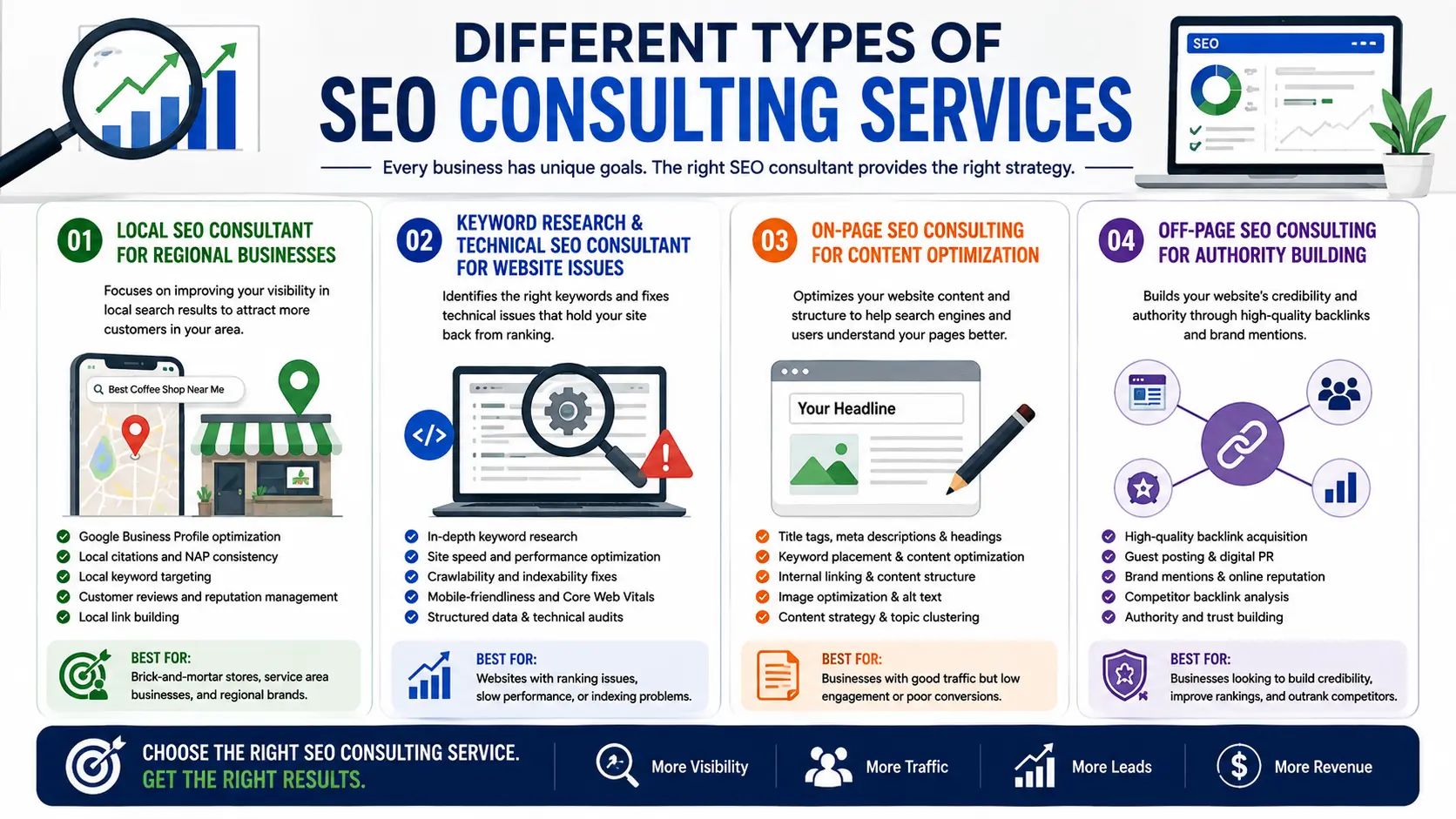
Specialization determines which search engine optimization consultant fits your specific visibility challenges. Different consulting disciplines address distinct ranking barriers. Matching the right expertise to your situation accelerates results.
Local SEO Consultant for Regional Businesses
Local SEO focuses on growing visibility in location-based search results for businesses with physical locations or serving specific geographic areas. Google recognizes local search intent better than ever. Sites that ensure presence across providers like Yelp, Foursquare, Facebook and Bing see boosts in local searches within their immediate city scope. Around 46% of all Google searches have local intent, while 76% of people searching on smartphones for something nearby visit a business within a day. A local SEO consultant optimizes Google Business Profile and manages citations across directories. They encourage customer reviews and create location-specific pages.
Technical SEO Consultant for Website Issues
Technical SEO consultant services focus on website structure and performance so search engines can crawl, understand and rank pages. Nearly 73% of clicks in search results go to organic listings, but technical issues prevent websites from appearing at all or with any prominence. Technical consultants fix coding problems and improve site architecture. They resolve indexing issues, optimize rendering and boost performance speed. Around 40% of potential customers leave websites that load slowly.
On-Page SEO Consulting for Content Optimization
On-page SEO consulting optimizes individual web pages to improve rankings and attract relevant organic traffic. This has target keyword placement, accurate title tags and meta descriptions, content structured with proper headings, unique helpful content, internal links and optimized images. On-page optimization makes pages easier for both search engines and users to understand.
Off-Page SEO Consulting for Authority Building
Off-page SEO covers activities performed outside your website to improve search rankings through building backlinks and brand authority. Quality backlinks from reputable websites act as votes of confidence and signal content value to search engines. Off-page consultants develop editorial link building strategies and pursue digital PR opportunities. They reclaim unlinked brand mentions and build relationships with industry publications. A single high-quality backlink from a trusted industry publication can affect rankings more than dozens of on-page optimizations.
Evaluating If SEO Services Are Worth It for Your Business
“A well-optimized page can drive traffic for years without ongoing ad spend, unlike PPC, where costs scale with clicks.”
Deciding whether hiring an SEO consultant justifies the investment requires you to explore measurable returns against costs and timelines. Professional services deliver quantifiable business outcomes when executed properly.
Expected ROI from SEO Consulting
SEO generates median returns of 748%, meaning roughly $7.48 back for every dollar spent. Industries with high customer lifetime value see even stronger performance. Financial services report 1,031% ROI, and medical devices reach 1,183%. B2B SaaS companies achieve 702% returns. Cross-industry data shows SEO leads close at 14.6% compared to just 1.7% for outbound marketing. Organic search accounts for 44.6% of all revenue attributed to digital channels.
Timeline for Seeing Results
Results typically appear within 6-12 months. You can achieve positive ROI in this timeframe. Peak results emerge in the second or third year of sustained effort. Google’s own guidance confirms SEO needs four months to a year to implement improvements and see benefit. Small businesses often see measurable results in 3-6 months. Competitive industries require 6-12 months for substantial impact.
Comparing DIY SEO vs Professional Services
DIY SEO costs mainly time plus $50-200 monthly for simple tools. Professional services range from $1,500 to $5,000+ monthly depending on scope. Agencies achieve faster results through established processes and resources. Both approaches require 4-6 months for outcomes that matter. Professional help brings collective knowledge from clients of all types and proven strategies.
Long-Term Value vs Short-Term Costs
SEO continues delivering traffic without incremental spend after the investment. Paid ads stop producing results when budgets end. SEO gains momentum over time. Organic search costs 61% less per lead than paid advertising while delivering higher conversion rates. Companies that stop SEO investment experience 15-30% annual decreases in organic lead generation.
The Final Thoughts
Losing customers to competitors through poor search rankings costs real money. One business lost more than $1,100,000 annually when organic leads dropped, as the data showed. Professional SEO consulting delivers measurable returns with median ROI of 748%. Organic leads close at 14.6% compared to just 1.7% for outbound marketing.
We recommend hiring an SEO consultant when you’ve identified ranking gaps that cost you customers. Results take six months, so starting today protects revenue tomorrow. You might need technical fixes or content development, depending on your specific visibility barriers. Professional intervention outperforms scattered DIY efforts for competitive recovery.
FAQs
Q1. How much does it typically cost to hire an SEO consultant? Professional SEO consulting services generally range from $1,500 to $5,000+ per month depending on the scope of work and your business needs. For smaller businesses or one-time projects like comprehensive audits, costs may start around $300 – $1,500. The investment varies based on whether you need ongoing services or specific deliverables like technical fixes, content strategy, or link building.
Q2. How long does it take to see results from SEO consulting? Most businesses see initial results within 6-12 months of implementing SEO improvements. Small businesses in less competitive markets may notice measurable changes in 3-6 months, while competitive industries typically require 6-12 months for substantial impact. Peak results generally emerge in the second or third year of sustained effort, as SEO builds momentum over time.
Q3. Can I do SEO myself or should I hire a professional? You can handle basic SEO yourself, but it typically takes about three times longer than hiring a professional. DIY SEO costs mainly your time plus $50-200 monthly for tools, while professionals bring established processes, collective knowledge from multiple clients, and proven strategies that deliver faster results. The decision depends on whether you have more time or money available, and whether your time is better spent growing your core business.
Q4. What’s the expected return on investment from SEO services? SEO generates a median ROI of 748%, meaning approximately $7.48 back for every dollar spent. Organic search leads close at 14.6% compared to just 1.7% for outbound marketing, and organic search accounts for 44.6% of all revenue attributed to digital channels. Industries with high customer lifetime value see even stronger performance, with some sectors reporting over 1,000% ROI.
Q5. What should I focus on first for local business SEO? Start by setting up and optimizing your Google Business Profile, as 46% of all Google searches have local intent and 76% of people searching on smartphones for something nearby visit a business within a day. Ensure your profile includes complete information, photos, and encourage customer reviews. This foundation is essential before investing in broader SEO efforts, as the local map pack captures 42% of all clicks for local searches.

